Tired of wondering whether the dice are rigged? Before every match the game creates a secret key that decides every roll and shows you its fingerprint, the Dice Seal. When the match ends the key is revealed and the Verify screen rebuilds every roll from it, so you can see that nothing changed during play. The computer never sees future rolls. Play the computer at four levels or a friend on the same phone, with Turkish tavla or international rules, on hand-rendered wooden boards. Works fully offline, no account needed. Free to play with ads between matches; a one-time purchase removes them.
What’s inside
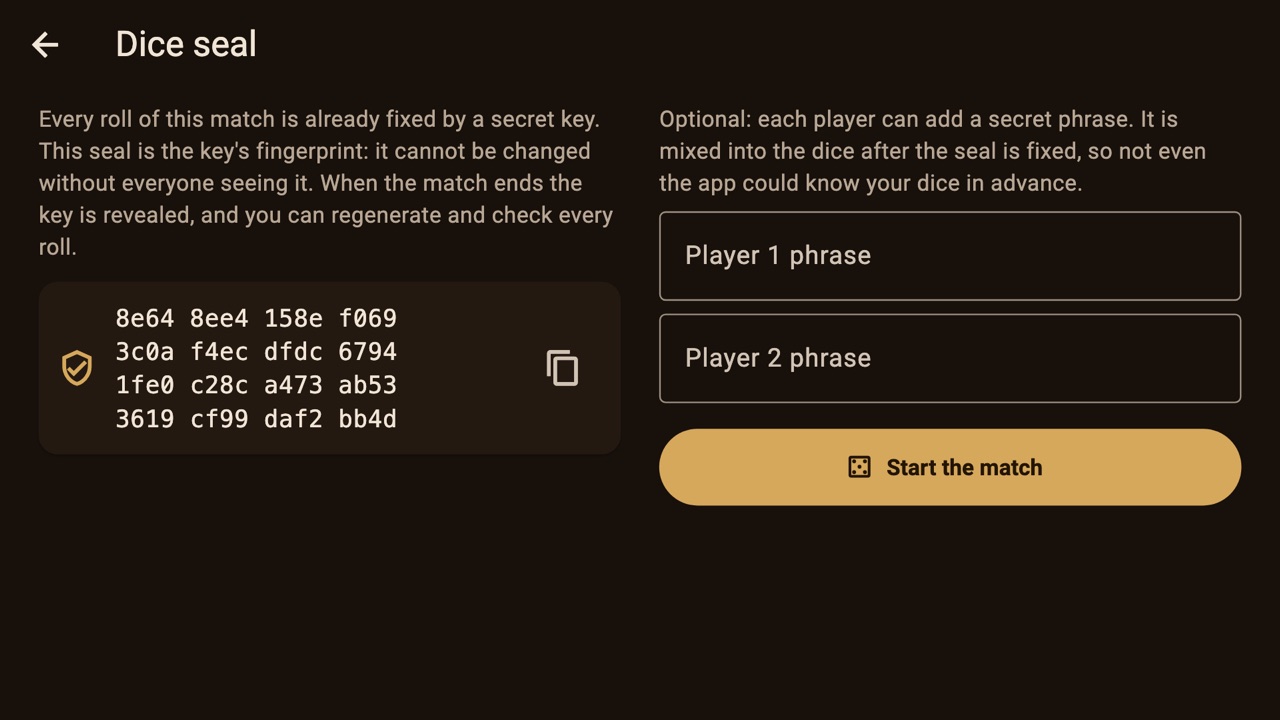
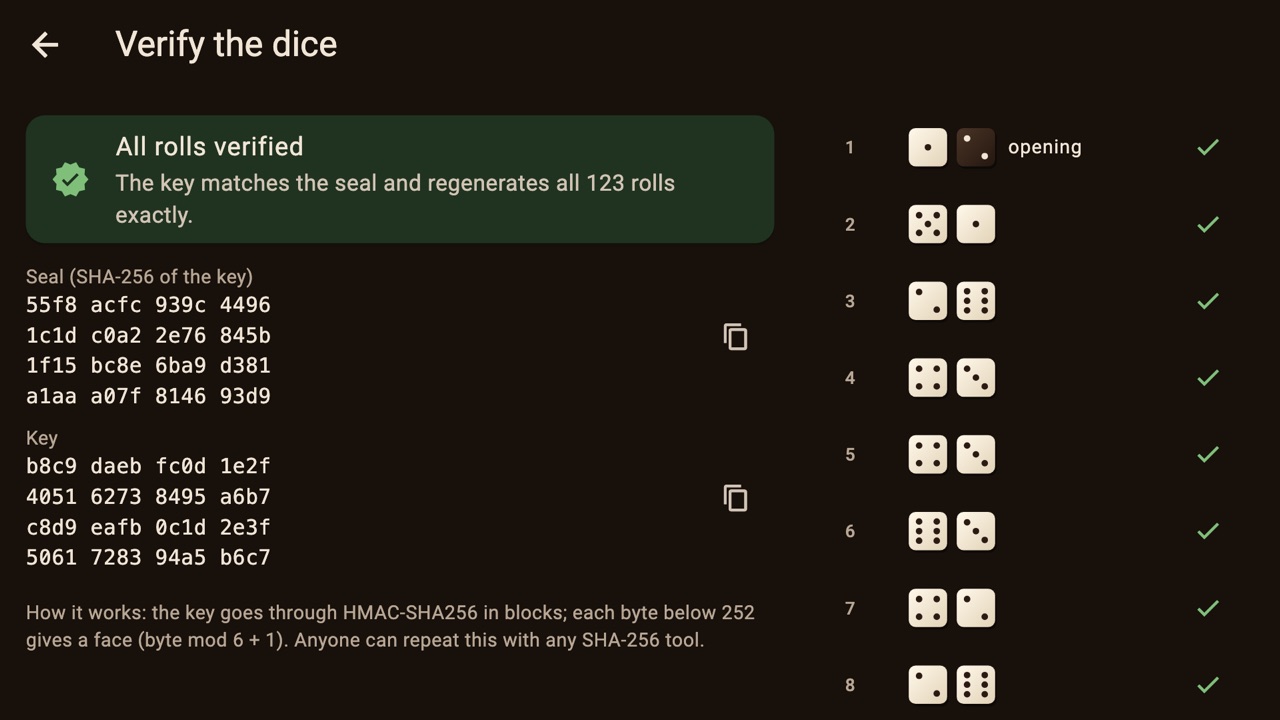
- Dice you can verifyA secret key fixes every roll before the match; its SHA-256 fingerprint is shown up front. After the match the key is revealed and every roll can be rebuilt and checked, with any SHA-256 tool if you like.
- Four computer levelsFrom a relaxed beginner to a champion that thinks ahead. The computer plays only with the dice on the table, just like you. Or play a friend on the same phone.
- Turkish or international rulesTurkish tavla without the doubling cube, or international backgammon with the doubling cube, gammon, backgammon and the Crawford rule. Matches of 1, 3, 5 or 7 points.
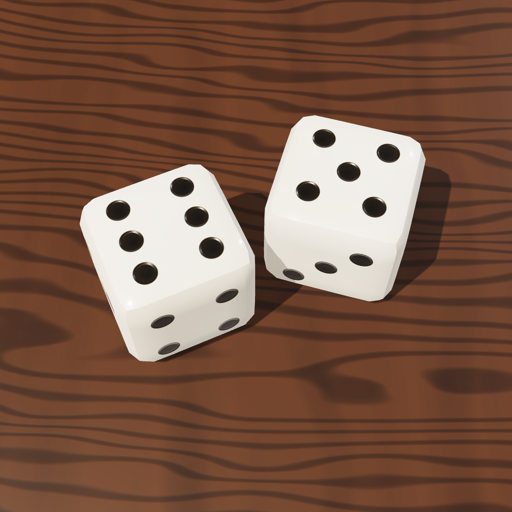
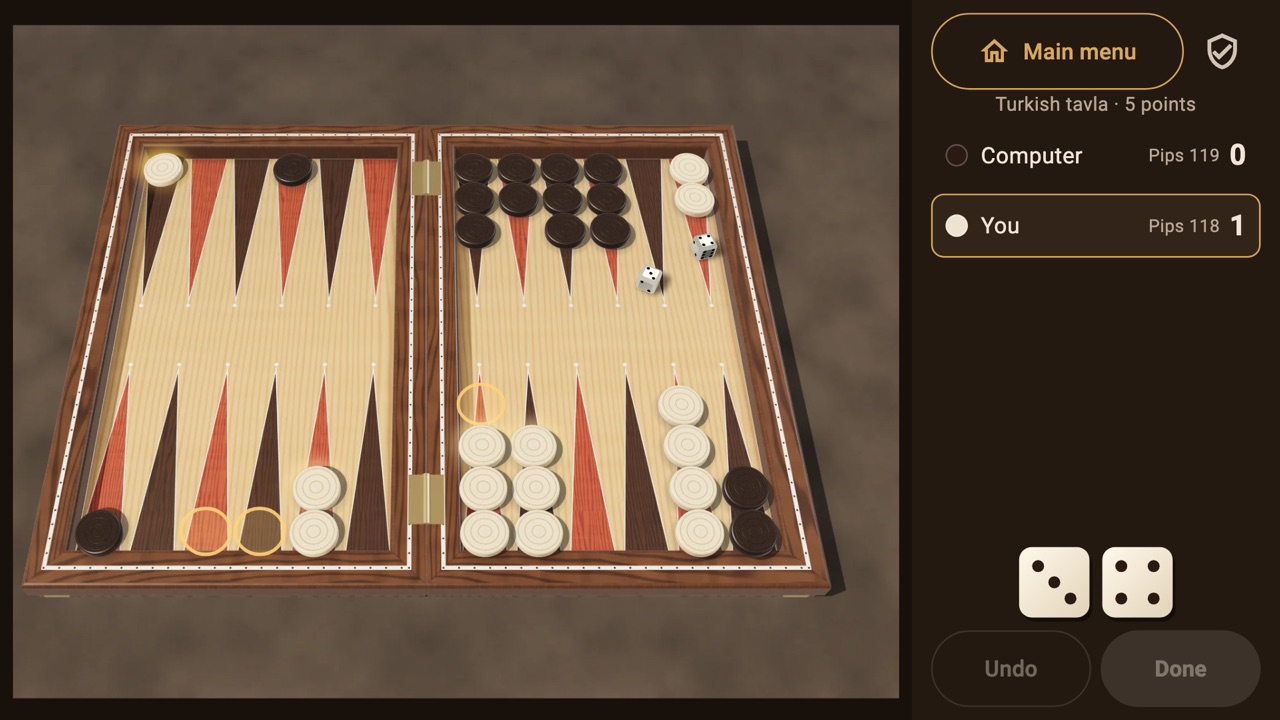
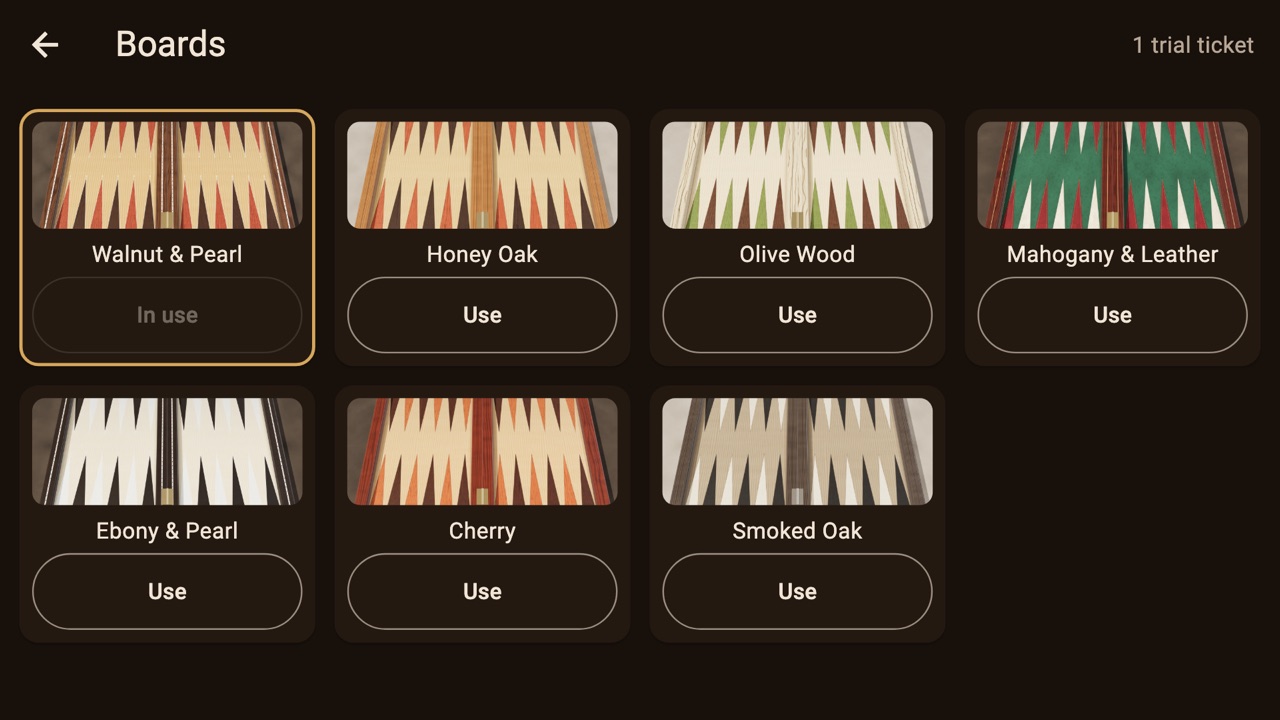
- Real wooden boardsSeven hand-rendered backgammon cases on a table, with 3D dice that bounce on the wood and stop on the sealed face.
How to play
Play backgammon against the computer or a friend on the same phone. Before a match, pick Turkish tavla or International rules and a match length of 1, 3, 5 or 7 points.
The basics
Each side has 15 checkers. The goal is to bring all of them into your home board and then bear them off before your opponent does.
- Roll and move. Move one or two checkers by the number on each die. A double is played four times.
- Where you can land. You may land on any point that does not hold two or more of your opponent’s checkers.
- Use as much of the roll as you can. Play both dice if possible; if only one can be played, it must be the larger one when possible. The game only offers legal plays.
- Hitting. A single checker on a point is a blot. If an opponent lands on it, it goes to the bar and must re-enter in the opponent’s home board before any other checker of that side can move.
- Bearing off. Once all 15 of your checkers are home, take them off with the exact number. A higher number may be used to bear off from your highest occupied point.
Turkish tavla or International
- Turkish tavla: no doubling cube. A normal win is 1 point, and a mars (the loser has borne off nothing) is 2 points; there is no 3-point win. The player who wins the opening roll then rolls both dice for their first move, and the winner of a game starts the next one.
- International: the opening roll, one die each, is played as the first move. A gammon is 2 points, a backgammon (the loser still has a checker on the bar or in the winner’s home board) is 3 points, and the doubling cube can multiply the stake of a game. In matches, the Crawford rule applies: when one player is one point from winning, the cube is out of play for the next game.
Fair dice
Before the first roll, the game shows the Dice Seal, the SHA-256 fingerprint of a secret key that fixes every roll of the match. When the match ends the key is revealed, and the Verify screen rebuilds all rolls from it and checks them against the seal.
Strategy tips
- Make points, not just progress. Two checkers together on a point can’t be hit and block your opponent. Early on, building points in your home board and just outside it is usually worth more than racing.
- Know the classic openings. 3-1 makes your 5-point, 6-1 your bar point and 4-2 your 4-point.
- Count pips. The game shows each side’s pip count, the total distance left to bear off. If you are clearly ahead, play safely and race; if you are behind, you need contact and hits.
- Leave blots out of direct range. Within six points a blot is easy to hit; further away it takes a combination.
- Build a prime. Six blocking points in a row trap any checker behind them. Even four or five in a row make escape very hard.
- International only: think about the cube early. Double when you are clearly better but the game is not yet lost for the other side; take a double when you still have a reasonable chance, roughly one in four or better.
Common mistakes
- Running every checker home and abandoning the back. Leaving your last two checkers deep in the opponent’s board for too long can see them trapped behind a prime.
- Forgetting the mars. In Turkish tavla a mars is worth double. When the game is lost, get at least one checker off to save the extra point.
- Moving too fast. With “Finish turn automatically” off, you can step back any checker move within your turn before confirming it.
A short history
Backgammon-family games are among the oldest board games still played, with a long history across the Middle East and the Mediterranean. The Turkish name tavla is related to the Greek tavli, and both are usually traced back to tabula, a Roman-era board game. The doubling cube came much later, in American clubs in the 1920s; traditional Turkish tavla is still played without it.
Controls and accessibility
On a phone the game is played in landscape. Tap a checker, then one of the highlighted points; double-tap a checker to play the larger die with it. Turn on “Finish turn automatically” if you prefer not to confirm each turn. You can also play in your browser.
The four computer levels are Beginner, Coffeehouse, Master and Champion. There are seven wooden boards, and the 3D dice land on the face fixed by the seal.
FAQ
What are the dice statistics?
It counts the faces and doubles you have rolled and compares the spread with fair dice using a chi-square test.
What does the match analysis show?
It compares your moves with the Master level’s evaluation: how often you found its best move and how much winning chance you gave away.
Does the computer play with better dice on higher levels?
No. Every level uses the same sealed rolls. Higher levels simply look further ahead when choosing a move.
Guides for Fair Dice Backgammon
FAQ
How can I be sure the dice are fair?
The seal is shown before the first roll and cannot match a different key. When the match ends, open Verify: it rebuilds every roll from the revealed key and checks it against the seal. The method is written on that screen, so you can repeat it with any SHA-256 tool.
Can I play without installing anything?
Yes. Press "Play free · In your browser" on this page. The browser version has no ads and no purchases; your games are saved in that browser only.
Do I need an internet connection?
No. The app plays fully offline and needs no account. Your statistics and settings stay on your phone.