
A relaxed but tricky billiards game: play 3-cushion and carom against computer opponents on 16 tables, win tournament cups, build up your bankroll and buy new cues and cosmetic items in the market. You can also challenge a friend online with a room code. Aim, pull back and release. Game money and diamonds are virtual and can also be bought in the game.
What’s inside
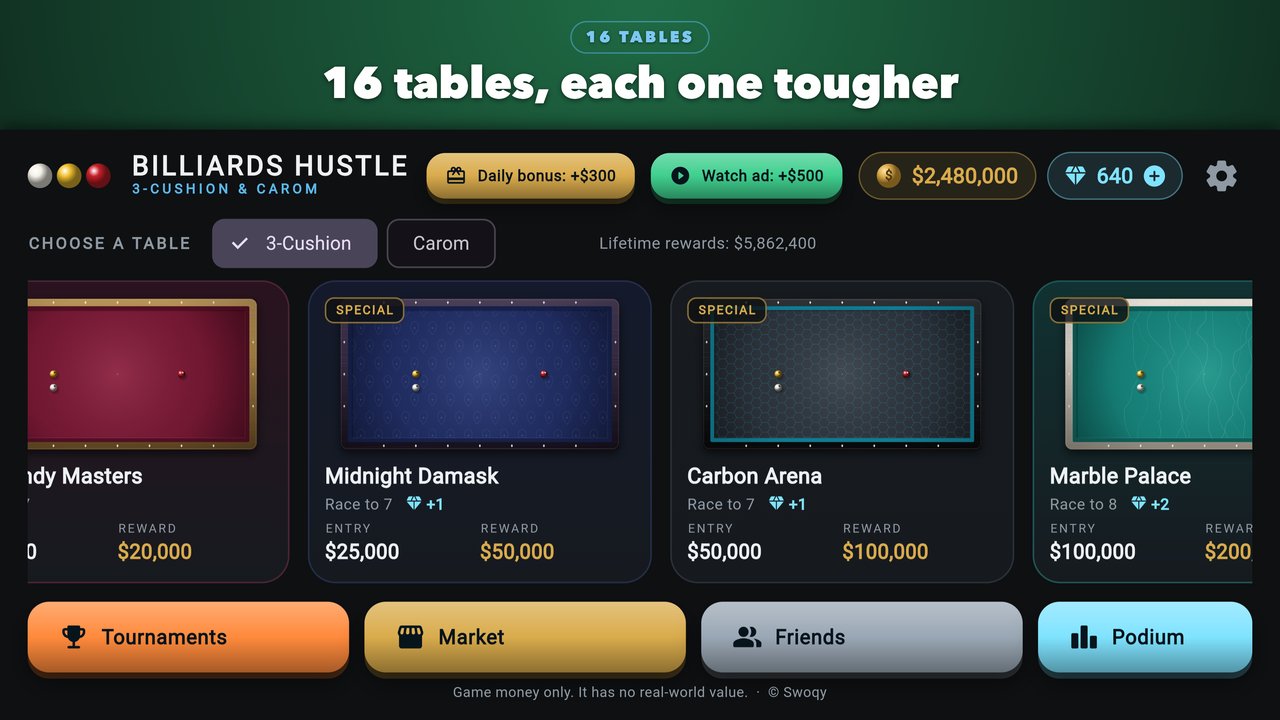
- 16 tables3-cushion and carom against computer opponents of rising skill, plus tournament cups.
- Simple controlsAim, pull back, release. Easy to learn, hard to master.
- Virtual money onlyGame money and diamonds are virtual and can’t be cashed out. No real-money gambling.
- Sign-up optionalPlay right away as a guest, or sign in with email or Google to keep your progress on any phone.
How to play
Billiards Hustle is carom billiards: a table with no pockets and three balls. You play one cue ball, your opponent plays the other, and the red belongs to nobody. Nothing is ever potted. You score by making your ball touch both other balls in one stroke.
- Pick a rule. In 3-Cushion, your ball must touch at least three cushions before it reaches the second ball. Cushions hit before the first ball count too. In Carom, touching both balls is enough. The first table, Blue Hall, always plays Carom so beginners can learn the controls.
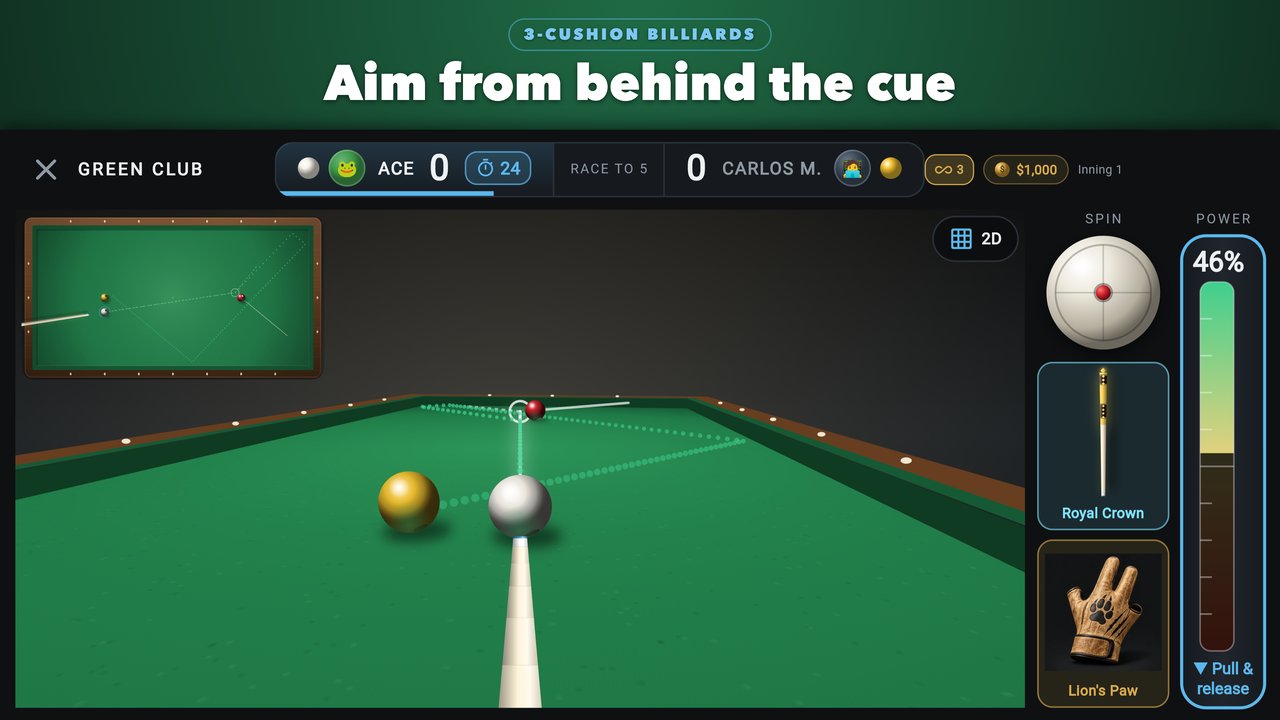
- Aim. Each turn starts with the cue pointing at your opponent’s ball. Drag on the table to turn it.
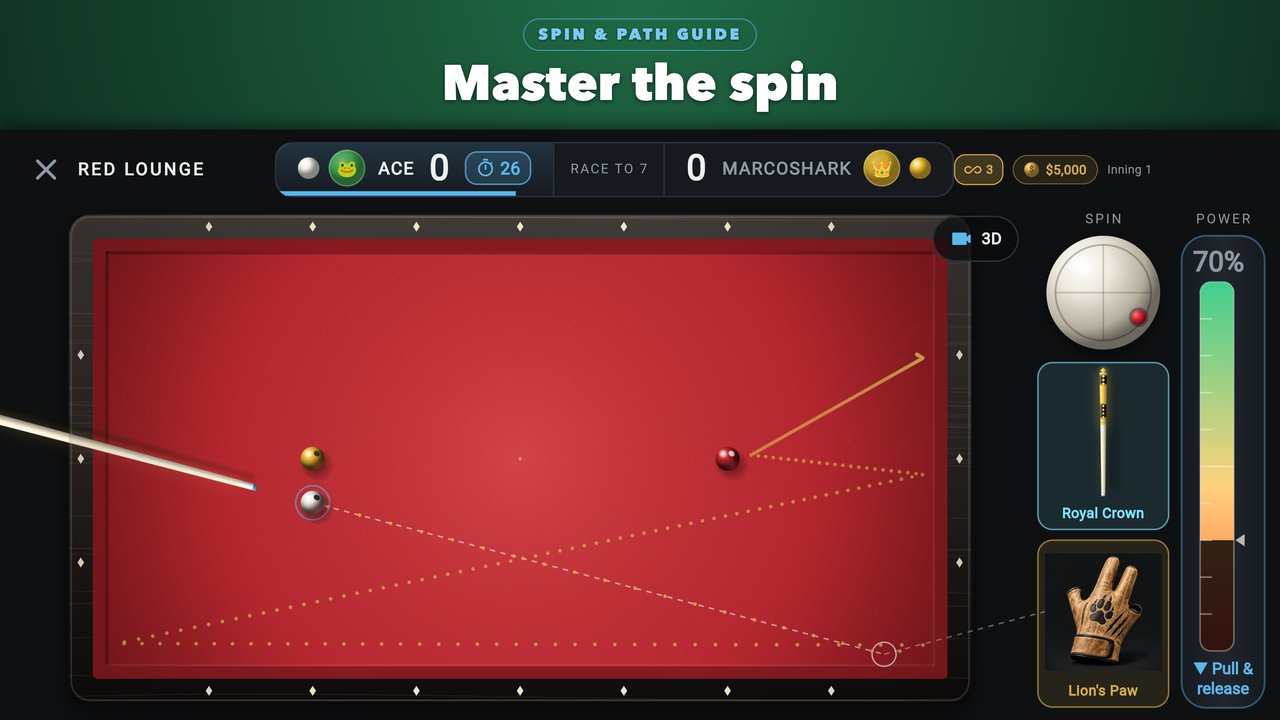
- Set spin. Drag the red mark on the small cue-ball picture. Up gives follow, down gives draw, and sideways gives side spin (“english”).
- Shoot. Pull the cue down to build power, then let go. If you let go near the top, the stroke is cancelled.
- Keep going or pass. Score and you shoot again. Miss and the turn passes. A message shows how many balls or cushions you reached.
Every shot has a 30-second clock, and if it runs out the turn passes. A match is a race to the number of points shown on the table card. In Carom that target is doubled.
Strategy tips
- Learn the long-short-long route. The most common three-cushion path runs from a long rail to a short rail and back to a long rail. Practice it on the easier tables until you spot it on sight.
- Use side spin to bend the rebound. Side spin makes the ball leave a cushion wider or tighter than plain geometry. If the natural angle carries your ball past the target, english on the matching side brings it back.
- Control how full you hit the first ball. A thin hit keeps most of your ball’s speed for the cushions. A full hit almost stops it. Three-cushion routes usually need the thinner contact.
- Use medium power. Hard shots scatter the balls. Medium pace with the right angle scores more often and keeps the balls close for your next point.
- Mind the leave on hard shots. When a point looks unlikely, leave the balls spread across the table. The computer opponent tests several shots before choosing, so a scattered table gives it fewer good options.
- Pick gear for feel. Cues differ in power, spin and the length of the aim line, and gloves reduce how far the stroke drifts from the line you set. A longer aim line and a steadier stroke help more than raw power.
Common mistakes
- Treating it like pool. Smashing the red and hoping sometimes works in Carom but rarely in 3-Cushion. Plan the route before you touch the power.
- Counting the wrong cushions. Only cushions before your ball meets the second ball count. A five-rail path that reaches the second ball after two cushions is still a miss.
- Running down the clock. Set the angle first, then the spin, then shoot.
- Moving up too soon. Higher tables have bigger entry fees and stronger opponents. A losing streak there drains your bankroll faster than steady wins on a table you can beat.
About three-cushion billiards
Carom billiards is played on a pocketless table, usually with two cue balls and a red object ball. Three-cushion is its best-known form and is played seriously across Europe, Asia and Latin America. A full-size match table is about 2.84 by 1.42 metres, the proportions the game simulates. Players are often rated by their average (points divided by innings), which the in-game scoreboard also shows.
Controls and accessibility
On a phone, everything is touch: drag the table to aim, drag the red mark for spin, and pull the cue down to shoot. In the browser version you do the same things by clicking and dragging with a mouse.
You can switch between a cue view and a view from above. Music, sound effects and vibration each have their own switch. There’s also a two-player mode for taking turns on one phone, with no game money involved.
Frequently asked questions
Which rule should a beginner start with?
Start with Carom. Without cushions to count, you can learn speed and contact first. Move to 3-Cushion once you score Carom points regularly.
What is the path guide?
It’s a limited supply of shots where the game draws your ball’s route for the current aim, spin and power. You can switch it on or off during a match, and each shot that uses it uses up one credit.
How do tournament cups work?
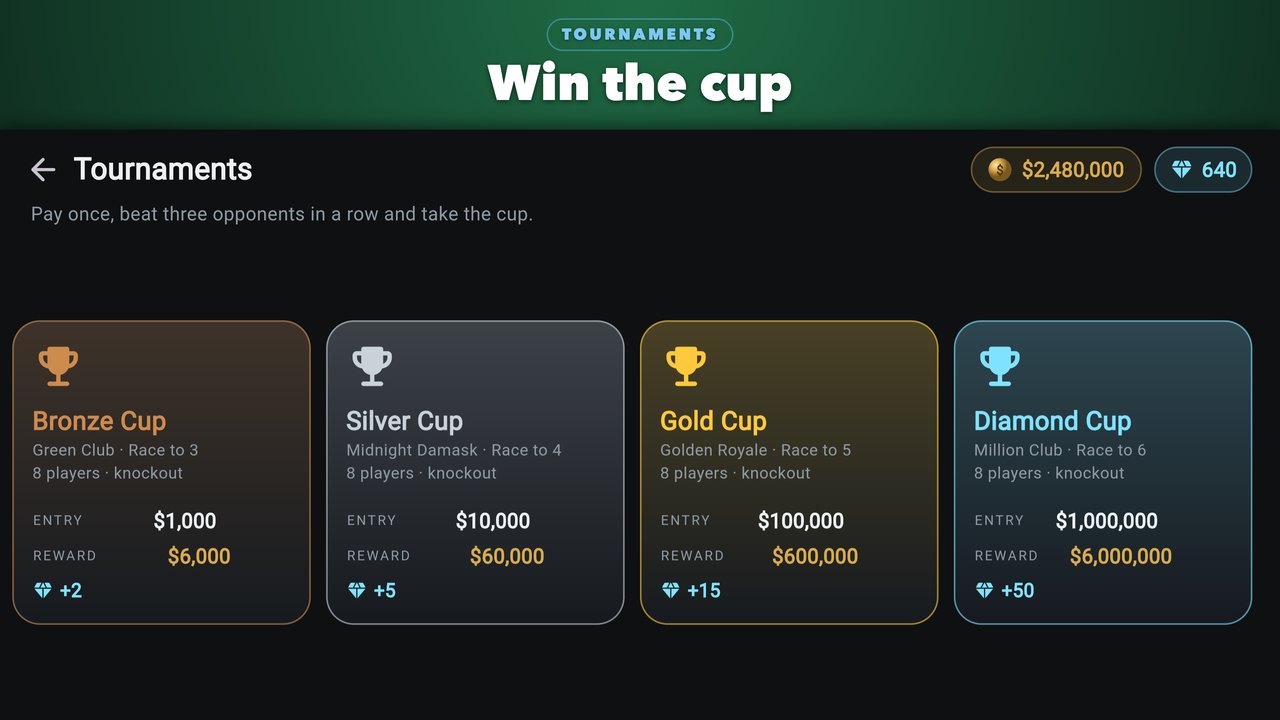
A cup is an eight-player knockout against computer opponents, with a quarter-final, a semi-final and a final. You pay the entry fee once, and if you win all three matches you take the prize. If you leave a cup early, the entry fee isn’t refunded.
Does a better cue win matches for me?
No. A better cue adds power, allows more spin and draws a longer aim line, but you still need the right angle and contact.
Guides for Billiards Hustle
FAQ
How do I play a friend online?
One of you taps Friends › Online room › Create room and sends the room code (the invite button shares it on WhatsApp, email and more). The other opens the game, taps Friends › Online room and enters the code. Both phones need the game; the links above get it.
Can I win real money?
No. Game money and diamonds are virtual. You can buy them in the game, but they can never be sold, withdrawn or exchanged for real money.
Where is my progress saved?
On your device, and it’s also backed up in the cloud under an anonymous ID. To delete it, use swoqy.com/delete-account.